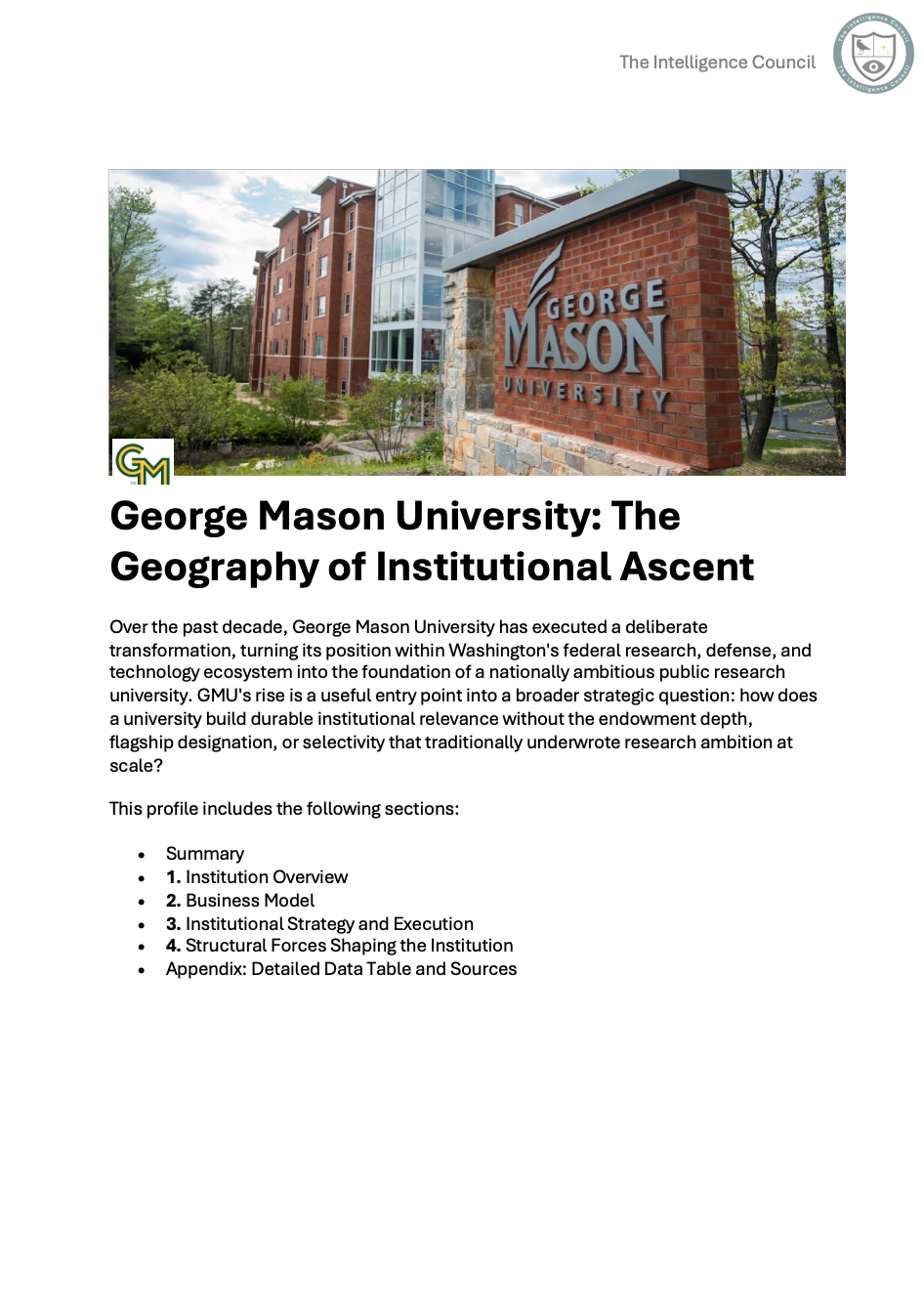
George Mason University: The Geography of Institutional Ascent
George Mason University: The Geography of Institutional Ascent
Couldn't load pickup availability
(Higher Education Institution Case Study | PDF)
GMU's rise to a nationally ambitious public research university is a useful entry point into a broader strategic question: how does a university build durable institutional relevance without the endowment depth, flagship designation, or selectivity that traditionally underwrote research ambition at scale?
This briefing distills verified data from institutional budget documents, state appropriations filings, NSF research rankings, and GMU's own strategic planning records into a structured, decision-grade format for senior institutional leaders.
What Does an Institutional Case Study Look Like? Free Examples:
What You'll Learn
Revenue Structure and Institutional Tradeoffs: How the university actually finances its operating model relative to peer institutions, where the underlying dependencies sit, and which parts of the model create long term leverage versus structural exposure.
Strategic Direction and Institutional Repositioning: What the institution has deliberately built, prioritized, scaled, or reoriented over the past several years across research strategy, workforce positioning, enrollment composition, industry alignment, operational structure, and institutional identity.
Structural Forces and Strategic Pressure Points: What the institution reveals about the broader pressures reshaping higher education, including demographic constraints, political exposure, research economics, labor market alignment, technological change, and the tradeoffs peer institutions are increasingly being forced to navigate.
Who It's For
Presidents, provosts, CFOs, and senior strategy teams at universities and higher education organizations benchmarking institutional strategy, research growth models, and financial resilience in a rapidly shifting funding and technology environment.
Share